Keywords
Ahmed Bey
reform
freed slaves
slavery system
How to Cite
Abstract
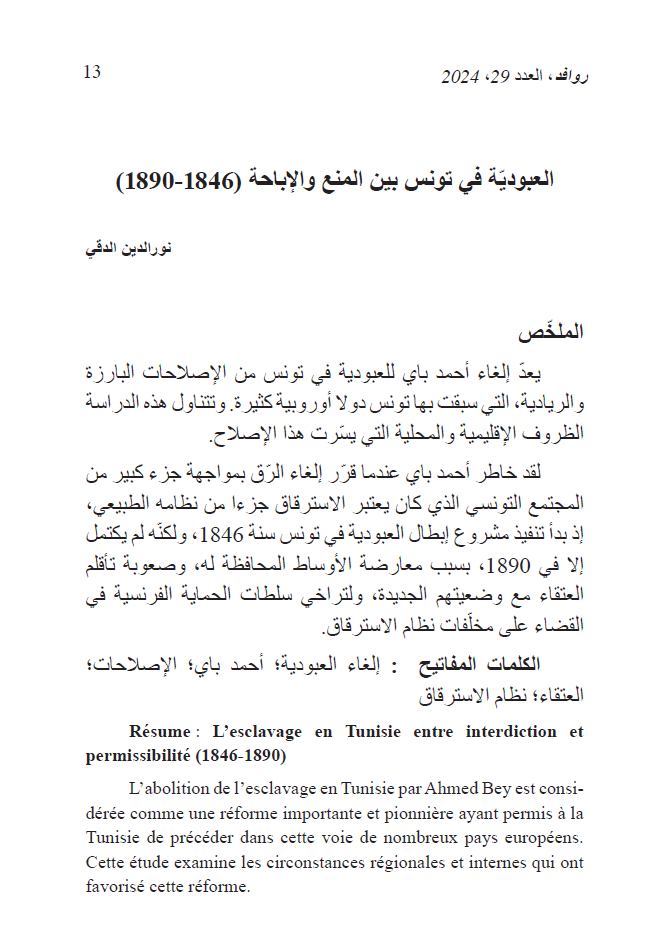
The abolition of slavery in Tunisia by Ahmed Bey is considered as an important reform and a pioneering act, as Tunisia preceded many European countries in this direction. This study examines the internal and regional circumstances that favored this change.
In initiating this reform Ahmed Bey took the risk of confronting a section of Tunisian society, which considered slavery as part of its natural order. Begun in 1846, the abolition of slavery was not completed until 1890 due to opposition from conservative circles, the difficulties of freed slaves in adapting to their new status and the laxity of the authorities of the French Protectorate in eliminating the after-effects of the slavery system.

This work is licensed under a Creative Commons Attribution-NonCommercial 4.0 International License.