Keywords
second half of the 20th century
Cold War crises
Bizerte battle
Non-Aligned Movement
How to Cite
Abstract
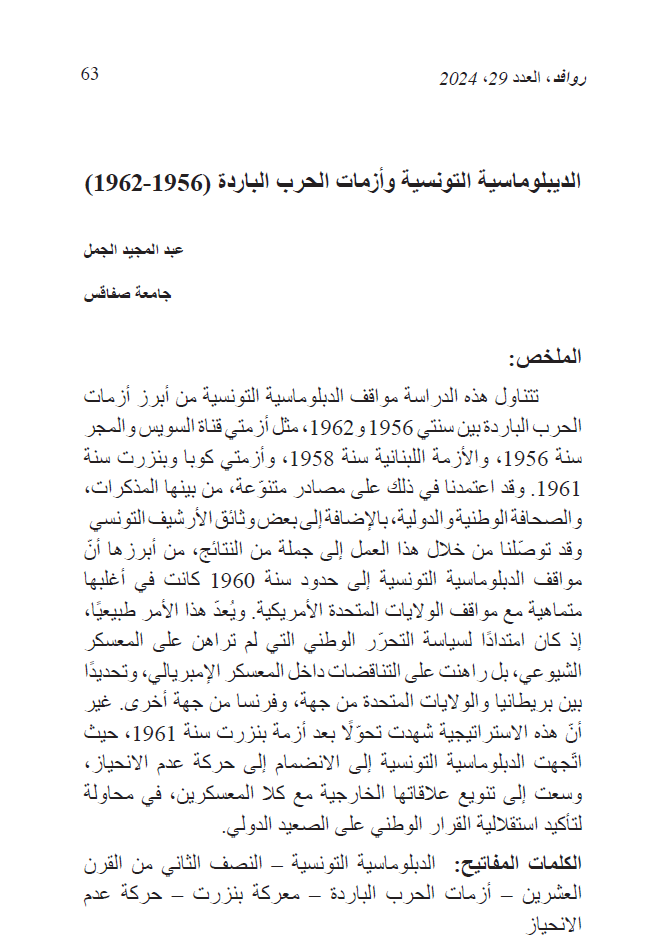
This study explores the positions adopted by Tunisian diplomacy during key Cold War crises between 1956 and 1962, including the Suez and Hungarian crises in 1956, the Lebanese crisis in 1958, and the Cuban and Bizerte crises in 1961. The analysis draws on a range of sources, including memoirs, national and international press, as well as selected documents from the Tunisian archives.
The findings indicate that until 1960, Tunisian diplomatic positions were largely aligned with those of the United States. This alignment was a natural extension of Tunisia’s national liberation strategy, which avoided reliance on the socialist bloc and instead sought to exploit contradictions within the imperialist camp, particularly between Britain and the United States on one hand, and France on the other. However, this strategy underwent a shift
following the Bizerte crisis in 1961, when Tunisian diplomacy moved toward joining the Non-Aligned Movement and sought to diversify its foreign relations with both blocs, in an effort to assert national decision-making independence on the international stage.

This work is licensed under a Creative Commons Attribution-NonCommercial 4.0 International License.
Copyright (c) 2025 عبد المجيد الجمل (المؤلف)